Skinbooster
What is Skinbooster?
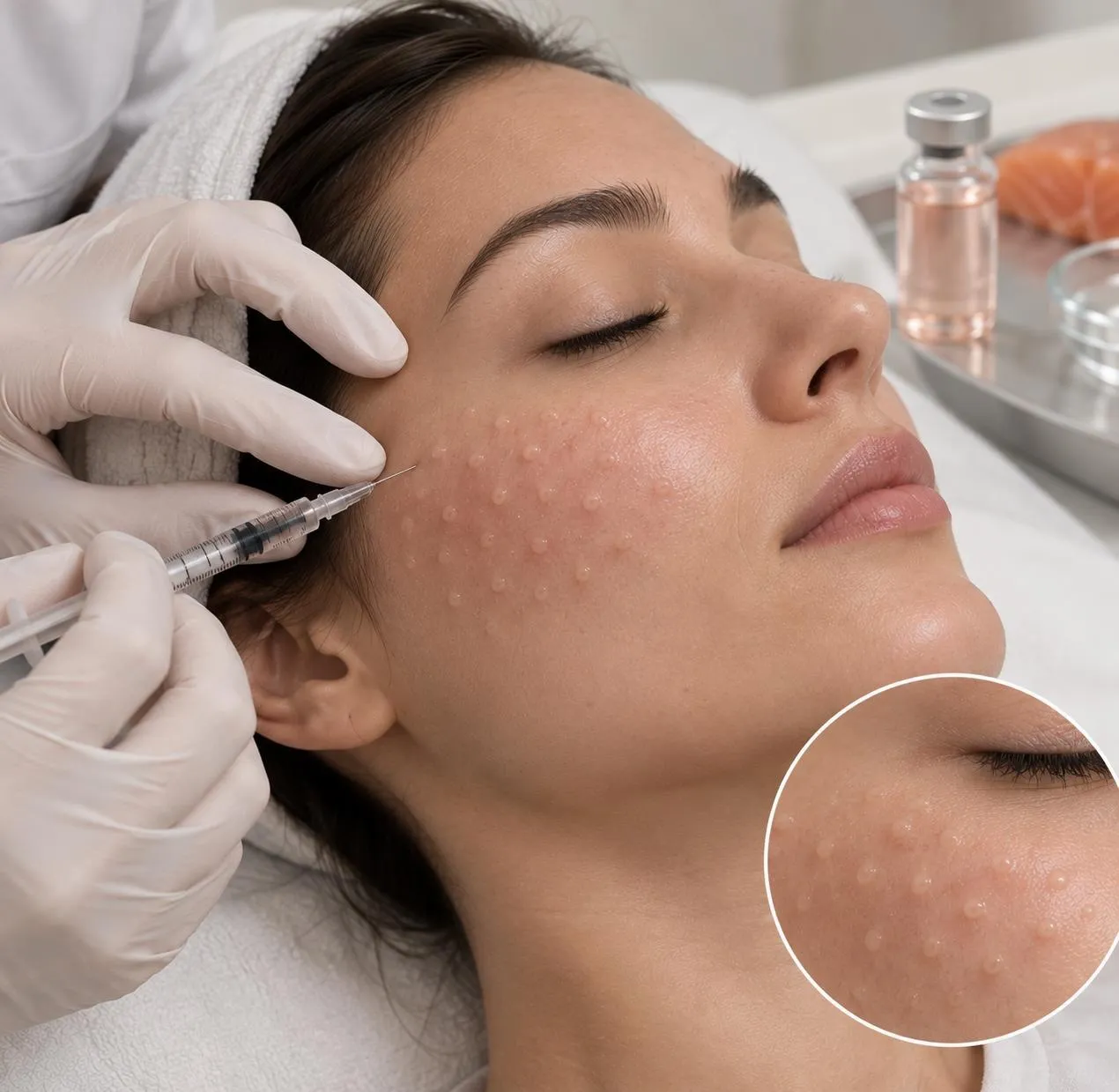
Skinboosters are injections of non-crosslinked hyaluronic acid. Hyaluronic acid is a substance that also occurs naturally in the skin and can bind water. Unlike volumising fillers, the preparation is not placed deep but distributed across the upper layers of the skin. The aim is to support the skin's moisture content and condition, not to increase volume.
Who is it suitable for?
- dry, dull-looking skin
- fine, superficial crepey lines
- skin with decreasing elasticity and firmness
- cheeks, neck, décolleté and the backs of the hands
- alongside an existing skincare or treatment routine
Benefits
- treats skin quality across an area rather than adding volume at a point
- the facial contour remains unchanged
- outpatient treatment without general anaesthetic
- can also be used outside the face, such as on the neck or hands
- breaks down gradually through the body’s own processes
How it works
- medical consultation on skin condition, previous illnesses and expectations
- cleansing and disinfection of the skin
- application of a numbing cream, left on for about 20 minutes
- placing small deposits into the upper skin layers with a fine needle or microcannula
- cooling of the treated areas and discussion of aftercare
How many sessions?
3 sessions as an initial course, roughly 4 weeks apart. followed by a top-up, generally every 6–9 months.
After the treatment
- do not touch the injection sites or apply make-up for 24 hours
- avoid sauna, solarium and strong sun for about a week
- avoid intensive exercise on the day of treatment
- do not massage small raised areas unless medically advised otherwise
- use sun protection consistently
- seek medical attention immediately in case of severe or increasing pain, blanching of the skin, or livid discolouration
When are results visible?
A smoother skin surface is often noticed after 2–3 weeks — the result of the course can usually be assessed after 8–12 weeks.
Possible risks and side effects
- small palpable or visible bumps (papules) at the injection sites
- bruising, particularly on thin skin such as the neck or under the eyes
- swelling of the treated areas for several days
- redness and tenderness
- rarely, hypersensitivity reactions to components of the preparation
- very rarely, infection or persistent nodule formation
- very rarely, vascular occlusion through accidental injection into a blood vessel
Skinboosters and fillers are not the same thing
This distinction is the most important point on this page, because it is the one that most often leads to mistaken expectations. Both methods use hyaluronic acid, but they pursue different aims and use differently prepared products.
Volumising fillers consist of crosslinked hyaluronic acid. Crosslinking means the individual hyaluronic acid chains are chemically bonded to one another. This produces a firmer, shape-stable gel that offers resistance to the surrounding tissue. It is placed deliberately into deeper layers in order to build volume at a particular point or to emphasise a contour — at the cheek, chin or lip, for example.
Skinboosters consist of non-crosslinked hyaluronic acid. It is thinner, does not remain in place as a shaping deposit, and is distributed in small quantities across the upper layers of the skin. It lifts nothing and shapes nothing. Its role is to bind water in the skin and hydrate the environment around the skin’s own cells.
In practice this means: anyone hoping a treatment will give them fuller cheeks, a more defined chin or a lifted area of the face will be disappointed by skinboosters — that is not what they are made for. Anyone wanting to address a dry, dull skin surface with fine crepey lines, without anything changing in their facial expression or proportions, is describing what this method aims at.
What can happen in the skin
Hyaluronic acid can bind many times its own weight in water. Introduced into the upper layers of the skin, it can hold additional moisture there for a time. Better hydrated skin generally looks smoother, reflects light more evenly and makes very fine surface lines less pronounced.
An indirect effect is also discussed: the fine punctures and the presence of the hyaluronic acid may stimulate the skin’s own connective tissue cells, the fibroblasts. Fibroblasts produce collagen and elastin among other things — the proteins that give skin firmness and stretch. How much this contributes to the result in an individual person cannot be said in advance.
Other methods target skin quality as well, each with its own evidence base and its own contraindications. Which option is appropriate in an individual case belongs in a medical consultation.
Not everyone experiences a visible change. How clearly the skin responds depends on factors including its starting condition, age and lifestyle, and cannot be predicted beforehand.
For whom the method is less suitable
Skinboosters act on the condition of the skin, not on its quantity and not on its position. Where skin is markedly lax with sagging areas, an injection treatment of this kind cannot achieve tightening in the sense of a surgical or device-based measure. Deep lines caused by muscle movement or volume loss are likewise not smoothed by it.
Active skin conditions also set limits. In inflammatory acne, rosacea during a flare, eczema or infection in the intended treatment area, the skin condition should be treated first. With known hypersensitivity to hyaluronic acid preparations, certain autoimmune conditions, coagulation disorders or blood-thinning medication, careful individual assessment is required. The treatment is not carried out during pregnancy or breastfeeding.
And finally: a skinbooster replaces neither sun protection nor basic skincare nor the investigation of suspicious skin changes. Anyone noticing a new or changing spot on the skin should have it examined dermatologically before an aesthetic treatment is planned. The information on this page is general and does not replace personal medical advice.
Frequently asked questions
- Will I look fuller afterwards?
- No. Skinboosters are not intended to build volume or change contours. They target the condition of the skin. Anyone wanting a change in volume needs a different method.
- What are the small bumps after treatment?
- The deposits placed in the skin can initially be felt as small raised areas. They usually settle within a few days. If they persist longer, they should be assessed medically.
- Is one session enough?
- As a rule, no. Skinboosters are usually planned as a course of three sessions roughly four weeks apart.
- How long does the result last?
- The hyaluronic acid is broken down by the body. Experience suggests a top-up after 6–9 months, depending on skin condition, lifestyle and sun exposure.
- Are there contraindications?
- Skinboosters are not suitable in cases including inflammation or infection in the treatment area, known hypersensitivity to hyaluronic acid preparations, certain autoimmune and coagulation disorders, and during pregnancy and breastfeeding. This is clarified during the consultation.