Dr. Melis Sökmen

Injection lipolysis for a double chin
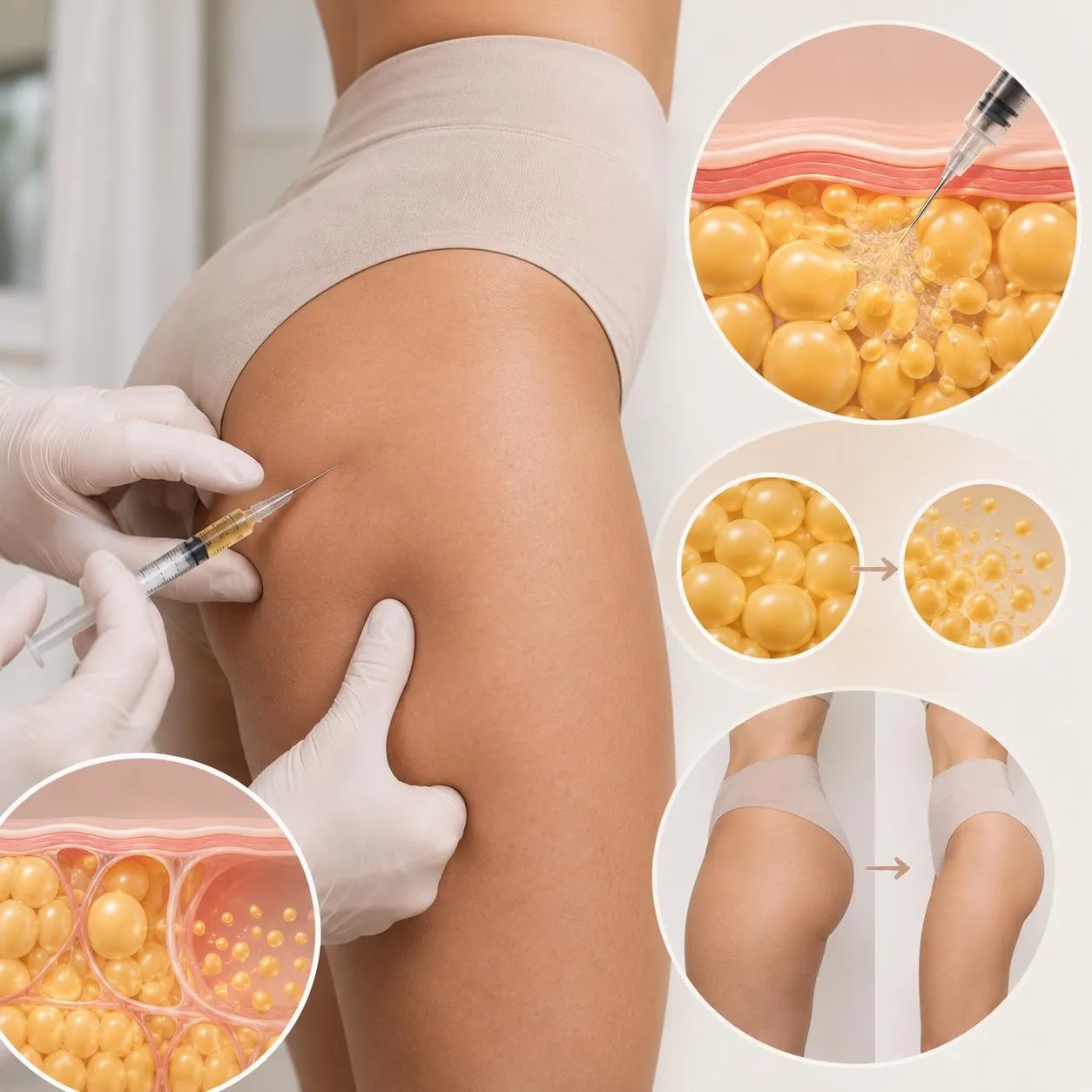
What is Injection lipolysis for a double chin?

In injection lipolysis, an active substance is introduced into a localised fat deposit under the chin. It can dissolve the membrane of the fat cells in this area, so that the cell contents are released and carried away through the metabolism. The breakdown happens slowly over several weeks and is accompanied by a pronounced phase of swelling.

Who is it suitable for?

  • a localised fat deposit under the chin in someone of otherwise normal body weight
  • good skin elasticity at the neck
  • fat deposits that do not change with diet and exercise
  • people who wish to avoid surgery and can plan for several sessions

Benefits

  • outpatient treatment without incision or general anaesthetic
  • targeted treatment of a clearly defined area
  • the treatment can be dosed in several steps
  • no general anaesthetic and no hospital stay required

How it works

  1. medical examination of the area, assessment of skin elasticity and exclusion of other causes
  2. consultation, photographic documentation and marking of the treatment field
  3. disinfection and optionally a surface numbing cream
  4. injection across a grid of fine puncture points within the marked area
  5. cooling, observation and discussion of the swelling phase

How many sessions?

2–4 sessions, depending on the findings, roughly 6–8 weeks apart. further sessions only as needed and after medical assessment.

After the treatment

  • cool the swelling regularly during the first few days
  • avoid intensive exercise, sauna and solarium for about a week
  • drink enough fluids and avoid alcohol in the first few days
  • take blood-thinning painkillers only after medical consultation
  • seek medical attention in case of severe pain, fever, redness or difficulty swallowing

When are results visible?

A change is often only visible after 4–6 weeks, once the swelling has subsided — the result of a session can usually be assessed after 8–12 weeks.

Possible risks and side effects

  • pronounced swelling of the chin and neck area over several days
  • tenderness and a feeling of tightness, sometimes for one to two weeks
  • bruising and redness in the treatment area
  • palpable firm areas and nodules that can persist for weeks
  • temporary numbness or tingling
  • irritation of a nerve branch with a temporarily asymmetric smile
  • difficulty swallowing
  • rarely infection, wound healing problems or tissue damage if the injection depth is incorrect
  • an uneven result, or a result that falls short of expectations

About the preparation used and its authorisation

Different preparations are used for injection lipolysis, and their status under medicines law differs. Whether the preparation used in an individual case is approved for this application, or is used outside its authorisation (off-label), is not a side issue: an off-label use carries extended duties of disclosure, the cost is not covered by statutory health insurance, and the responsibility for the indication weighs more heavily.

Ask explicitly during the consultation which preparation is used and what its authorisation status is for this application. This information is provided before treatment and documented in writing. You should not consent to the treatment without it.

Not a weight-loss treatment

This is the most common misunderstanding about the method, and the most important thing to be clear about. Injection lipolysis does not reduce body weight. It does not act on fat metabolism as a whole and it does not change how fat is distributed across the body. It addresses one clearly bounded deposit, nothing more.

Where a double chin results largely from overall body weight, treating that area is the wrong starting point. A change in weight would alter the region anyway, and the result of a treatment carried out beforehand would not be stable. In such cases the honest recommendation is to address body weight first and reassess the chin afterwards.

Why skin elasticity is the deciding factor

Reducing fat under the chin only improves the contour if the skin can follow the reduced volume. Skin with good elasticity contracts and adapts to the new shape. Skin that has already lost elasticity does not — in which case reducing volume can make the appearance worse rather than better, because the loose skin becomes more apparent.

Assessing this is part of the examination and cannot be judged from photographs. Age, sun exposure over a lifetime, smoking and previous weight changes all influence it. Where elasticity is insufficient, a surgical approach may be the more suitable option — or none at all.

The swelling phase is part of the treatment

The dissolved cell contents have to be broken down and transported away, and this process is accompanied by an inflammatory reaction. That is why swelling under the chin after this treatment is pronounced and clearly visible from the outside. It generally lasts 3–7 days, with tenderness and a feeling of tightness sometimes lasting one to two weeks.

This should be planned for. An appointment shortly before a wedding, a presentation or a holiday is a poor choice. Being told the swelling is “harmless” is not the point — the point is that it is visible, and you should know that before booking rather than afterwards.

Limits of the method

The result is not predictable in detail. How much a deposit reduces varies between individuals, and several sessions may be needed to achieve a visible change. It is possible for the result to fall short of expectations, and possible for it to be uneven.

The method does not replace liposuction where volumes are larger, and it does not address skin laxity. It is also not a treatment for the underlying reasons a deposit formed. The information on this page is general and does not replace an examination or a diagnosis.

Frequently asked questions

Will this make me lose weight?
No. Injection lipolysis is not a method of weight reduction. It addresses clearly localised fat deposits only and influences neither body weight nor overall fat distribution.
How severe is the swelling?
The swelling is part of how the treatment works and can be pronounced. It generally lasts 3–7 days. An appointment should be chosen so that this period is accounted for.
Is the result permanent?
Current understanding is that treated fat cells are broken down and not replaced; robust long-term data for this method is limited. The remaining fat cells in the surrounding area can still increase in volume with weight gain, so the appearance can change again.
What is the difference from liposuction?
Liposuction removes fatty tissue mechanically in a single procedure and can address larger volumes. Injection lipolysis works across several sessions on smaller deposits. Which method is appropriate depends on the findings and is assessed medically.
Are there contraindications?
The treatment is not suitable in cases including infection in the treatment area, coagulation disorders or blood-thinning medication, severe disease of the liver, kidneys or heart, autoimmune conditions, known hypersensitivity to the active substance, and during pregnancy and breastfeeding. An enlarged thyroid or lymph node as the cause of the chin contour must also be excluded beforehand.